“
In the kingdom of Christ there is no instrument of coercion. In it force has no place.
21MR 152.3-4
”
21MR 152.3-4

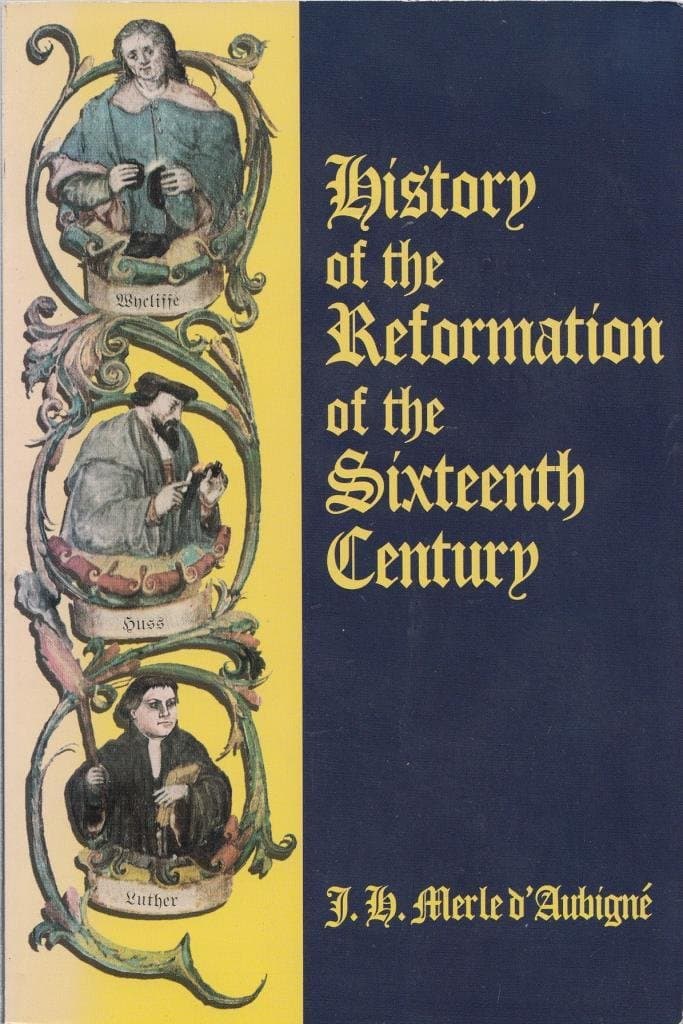
One of the most popular and important Protestant Histories of the Reformation. Quoted often in The Great Controversy.
CONTENTS
Volume 1: The Rise of the Reformation
Book 1: State of Europe Before the Reformation (to 1517) Covers the rise of the Papacy from the early church through Hildebrand, the replacement of grace with a system of works, penances, and indulgences, and surveys the state of Europe — its nations, its pre-Reformation witnesses (Wycliffe, Huss, Savonarola, Wessel), and its humanist scholars (Erasmus, Reuchlin).
Book 2: The Youth, Conversion, and Early Labors of Luther (1483–1517) Luther's parentage and schooling, his discovery of the Bible, the thunderstorm and entry into the Erfurt convent, his struggles during mass, his meeting with Staupitz who directed him to Scripture and grace, his call to Wittenberg, his journey to Rome, his doctoral oath, and his early lectures and theses.
Book 3: The Indulgences and the Theses (1517–1518) Tetzel's preaching tour, Luther's confrontations in the confessional, the posting of the 95 Theses and the letter to Archbishop Albert, the rapid spread of the Theses, Tetzel's counter-attack, and Luther's journey to Heidelberg.
Book 4: Luther Before the Legate (May–December 1518) Luther's "Resolutions," his summons to Rome (redirected to Augsburg), the introduction of Melanchthon, Luther's appearances before Cardinal Cajetan, his refusal to recant, his flight from Augsburg, and his appeal first to the Pope and then to a General Council.
Volume 2: The Breach with Rome
Book 5: The Discussion of Leipzig (1519) The debate between Luther/Carlstadt and Eck, in which Luther is pressed to affirm Scripture alone as the infallible authority, effectively breaking with the conciliar and papal legal structure of Rome.
Book 6: The Bull of Rome (1520) Luther's three great treatises including the Address to the Christian Nobility, the issuing of the papal bull, Luther's public burning of the bull at Wittenberg, and Zwingli's intervention in Switzerland.
Book 7: The Diet of Worms (1521) Day-by-day account of Luther's journey to Worms, his appearances before Emperor Charles V, his famous stand, and his subsequent seizure and removal to Wartburg Castle.
Book 8: The Swiss (1484–1522) Introduction of Zwingli and the Swiss Reformation, emphasizing that Zwingli began preaching the Gospel independently of Luther — d'Aubigné's argument that this proves the movement was a divine, not merely a human, work.
Volume 3: The Reformation Advances
Book 9: First Reforms (1521–1522) Luther at the Wartburg translating the New Testament; the chaos in Wittenberg under Carlstadt and the "prophets of Zwickau"; Luther's return to restore order through preaching the Word rather than force.
Book 10: Agitation, Reverses, and Progress (1522–1526) The Peasants' War, the death of Frederick the Wise, Luther's marriage to Katharine von Bora, and the continued spread and consolidation of the Reformation despite setbacks.
Book 11: Divisions — Switzerland and Germany (1523–1527) The growing theological rift over the Lord's Supper — Luther vs. Zwingli on the Real Presence — and its consequences for the unity of the Reformation.
Book 12: The French (1500–1526) The "Circle of Meaux" under Lefèvre d'Étaples and Bishop Briçonnet, France's own evangelical awakening predating Luther's fame, and its early persecution.
Volume 4: The Confession
Book 13: The Protest and the Conference (1526–1529) The First Diet of Spires and its grant of religious liberty; the Second Diet and the famous "Protest" of the evangelical princes; the Marburg Colloquy where Luther and Zwingli fail to reach agreement on the Supper.
Book 14: The Swiss — Religious War (1528–1531) Political and military tensions in Switzerland culminating in the Battle of Kappel (1531), where Zwingli is killed on the battlefield serving as a chaplain.
Book 15: Germany — The Confession of Augsburg (1530–1546) The drafting and presentation of the Augsburg Confession by Melanchthon, the formation of the Schmalkaldic League as a Protestant defensive alliance, and the political survival of the Reformation against imperial pressure.
Volume 5: The Reformation in England
Book 16: England to the Time of the Reformation (2nd century–1517) Early British Christianity and its long resistance to Roman encroachment, the Lollard movement, and the career of John Wycliffe as the "morning star" of the Reformation.
Book 17: The Revival of the Church (1516–1525) The intellectual awakening at Oxford and Cambridge, Erasmus's Greek New Testament and its catalytic effect on English scholars, and the first stirrings of evangelical faith in England.
Book 18: The Lollards and William Tyndale (1526–1528) Tyndale's struggle to translate the Bible into English, his flight to the Continent, the printing of the New Testament, and the smuggling of Bibles back into England.
Book 19: The Resignation of Wolsey (1527–1530) The intersection of Henry VIII's divorce proceedings with ecclesiastical politics; the rise and fall of Cardinal Wolsey and the gradual transfer of ecclesiastical authority away from Rome toward the Crown.
Book 20: The Breach with Rome (1529–1536) The legal and institutional break with Rome, the martyrdom of Tyndale, and the establishment of the Church of England — with d'Aubigné's insistence that while the King held the power, the Bible held the hearts of the people.